

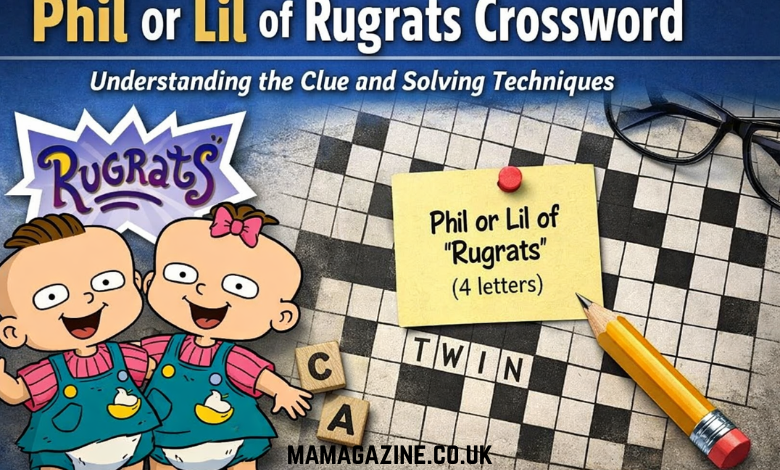
When tackling crossword puzzles, solvers quickly learn that each clue comes with its own set of intricacies. Some are straightforward, others are cryptic, but all of them are designed to make the solver think in ways that challenge both logic and memory. A recurring clue in many crossword puzzles is “Phil or Lil of Rugrats,” which might seem straightforward, particularly for fans of the animated show Rugrats. However, in crossword puzzles, the expected answer isn’t always as obvious as it seems.
The Question Behind the Clue
To those who have watched Rugrats, Phil and Lil are characters that are easily recognizable. They are twin siblings, known for their playful personalities and frequent antics on the show. So, why does the crossword clue ask for “Phil or Lil,” and what does it mean when the puzzle writer adds the phrase “e.g.” or “for example”? The subtle hint embedded in the clue changes everything.
In most cases, crossword puzzles aren’t just asking for a specific identity. Instead, they are usually looking for a classification, a description that applies to the characters in question. For example, when the clue reads “Phil or Lil of Rugrats,” with the added context “e.g.,” the puzzle is guiding you toward what the characters share, not who they are individually. The most straightforward solution to this clue is the word TWIN. The word fits perfectly into the crossword puzzle grid, and it succinctly encapsulates the shared characteristic of Phil and Lil.
Understanding the Logic of Crossword Clues
Crossword clues often rely on nuanced language that tests a solver’s ability to recognize patterns, relationships, and categories. A clue like “Phil or Lil, e.g.,” uses a common crossword device known as a category clue. It’s not asking for one specific individual (e.g., “Phil” or “Lil”), but rather what they represent collectively. Both Phil and Lil are twins. Thus, the crossword isn’t asking who they are but what they are.
This category-based approach is common in crossword construction. While one might think that a clue referencing characters from Rugrats would be looking for specific names, crossword clues often operate on a different level. The word “twin” categorically fits the puzzle’s structure and serves as the intended answer.
The Role of Clue Wording and Design
One of the reasons that TWIN is the most common answer to the “Phil or Lil of Rugrats” crossword clue has to do with how crossword clues are constructed and how crossword grids are designed. The grids themselves are meticulously created, often requiring words that are short, flexible, and fit neatly into the overall structure. Short words, like “TWIN,” have the added benefit of being easy to fit into a variety of positions in the puzzle without causing issues with intersecting answers.
Crossword constructors prioritize words that work well with other words, and TWIN is a simple, concise word that fits this criteria perfectly. This, in turn, makes it a frequent answer in puzzles, especially when a clue points to a shared category.
How Crosswords Develop Your Problem-Solving Skills
At first glance, this clue might seem like a trivia question about Rugrats. However, as experienced solvers will attest, crossword puzzles are about much more than recalling specific details or memorizing facts. They reward the ability to recognize relationships, generalize information, and think critically about language.
The key to solving a clue like “Phil or Lil of Rugrats” lies in understanding the underlying relationships between words and concepts. Instead of focusing solely on the characters’ names, the solver needs to think more broadly about what Phil and Lil represent as a pair. Once you identify them as twins, the answer becomes clear.
This kind of clue is part of a broader family of category-based clues in crosswords, where the solver is prompted to think in terms of categories or shared characteristics. Over time, crossword solvers develop the ability to identify these patterns, helping them become better at interpreting clues and solving puzzles.
Common Mistakes in Solving This Clue
Even though this clue is relatively straightforward, it’s still one that causes confusion for many solvers. One of the most common mistakes when attempting to solve this clue is rushing to answer with the names “Phil” or “Lil.” The problem with this approach is that crossword puzzles require precision in answering, and these names do not fit the structure or intent of the clue.
In crosswords, it’s crucial to pay attention to the language used in the clue. The phrase “Phil or Lil” might initially make solvers think that one of the names is the correct answer. However, the addition of “e.g.” or “for example” transforms the clue into one that asks about a shared trait rather than a specific individual. This subtle shift in language often catches new solvers off guard.
Another common mistake is overthinking the clue. Sometimes, when solvers encounter a seemingly simple clue like this, they assume there must be a trick to it. They may look for an obscure answer or an unusual word that could fit, when in fact, the correct answer is the most logical and straightforward one: TWIN.
The Importance of Checking Intersecting Answers
One useful strategy when solving crosswords is to check the intersecting answers. If you’re uncertain about the solution to a particular clue, it’s often helpful to look at the answers that cross it. If the letters from the intersecting clues form sensible, recognizable words, you can feel confident that you’re on the right track.
For example, if you’re unsure about the answer to “Phil or Lil of Rugrats,” you can check the intersecting clues for additional hints. If the letters fit with the other answers in the puzzle, you can safely fill in “TWIN” as the answer.
Why TWIN Shows Up So Often in Crosswords
The repetition of TWIN as the answer to this and similar clues can be attributed to several factors. First, as mentioned earlier, crossword constructors often prefer short words that are flexible and easy to fit into the grid. Words like “TWIN” are simple, fitting the constraints of the puzzle and providing a clean solution.
Second, the category-based nature of the clue makes it a reliable answer. Crosswords are designed to test not just recall but also reasoning and pattern recognition. Clues like “Phil or Lil of Rugrats” are a perfect example of this, as they challenge solvers to think about the relationships between characters rather than memorizing facts.
Lastly, TWIN is a word that fits neatly into the linguistic and structural design of crosswords. Its brevity and flexibility make it a staple answer in puzzles, particularly when the clue calls for a category or general description.
Understanding the Structure of Crossword Clues
Crossword puzzles are built around a framework of rules and patterns that solvers need to understand in order to succeed. When you look at a clue like “Phil or Lil of Rugrats,” it’s important to focus not just on the direct meaning but also on how the puzzle creator has constructed the clue. Here are a few key aspects of how crossword clues are designed:
Clue Categories
In many crossword puzzles, clues fall into different categories. Some clues ask for definitions, while others rely on wordplay or cryptic hints. The “Phil or Lil of Rugrats” clue is an example of a category-based clue, where the answer is not a specific name but a broad classification.
Grammar and Syntax
Crossword clues use specific grammatical structures to guide solvers. A clue that says “Phil or Lil, e.g.,” suggests that you’re not looking for a name, but instead a shared characteristic. The “e.g.” tells you that the answer is an example of a broader category.
Wordplay and Subtlety
Even seemingly simple clues require solvers to read carefully. Crossword writers use subtle tricks, such as implying a generalization or using indirect phrasing, which forces the solver to think beyond the obvious.
Patterns of Answer Lengths
Crossword puzzles are designed to have answers of specific lengths that fit the grid layout. Short answers like “TWIN” are often preferred because they’re easier to place in the puzzle without disrupting the grid’s structure.
Intersection of Clues
The interconnected nature of crossword puzzles means that solving one clue can often provide hints for others. The letters that intersect with the “Phil or Lil” clue may help confirm the correct answer, reinforcing the idea that the puzzle isn’t just about trivia knowledge but about strategy and pattern recognition.
Clue Redundancy
Some clues can appear multiple times in different puzzles, testing the solver’s ability to understand clues within different contexts. The repetition of “TWIN” in this type of clue shows how patterns emerge across puzzles, helping solvers develop stronger puzzle-solving skills over time.
The Puzzle-Constructing Philosophy
Crossword constructors work within a set of guidelines and constraints that help ensure the puzzle remains challenging, fair, and solvable. Each clue serves a specific purpose and contributes to the overall experience of the puzzle. Here’s how the construction philosophy affects clues like “Phil or Lil of Rugrats”:
Balancing Difficulty
The goal is to create a puzzle that isn’t too easy or too hard. Clues like “Phil or Lil of Rugrats” are a great example of the middle ground. It’s simple enough for most solvers to get, but it still requires careful reading to make sure the solver doesn’t fall into the trap of thinking it’s just asking for a name.
Incorporating Pop Culture References
Crossword puzzles often draw from a wide range of sources, including pop culture. Rugrats is a popular animated series, and using characters like Phil and Lil is a way to connect with solvers who are familiar with the show. These references make the puzzle feel more relevant and engaging.
Engaging the Solver’s Memory
While crossword puzzles don’t rely entirely on memory, they do test a solver’s ability to recall facts and understand relationships. “Phil or Lil of Rugrats” taps into the solver’s memory of the show, but it also tests their ability to generalize and classify information, rather than simply remembering individual details.
Ensuring Fairness
A good crossword puzzle strikes a balance between being solvable and providing a challenge. Clues that rely on straightforward facts, like the “Phil or Lil of Rugrats” clue, ensure that solvers are rewarded for paying attention and thinking critically, rather than simply guessing obscure facts.
Clue Variety
A well-constructed puzzle includes a range of clue types. Some will ask for definitions, others for puns, and some for generalizations like “Phil or Lil of Rugrats.” The variety keeps solvers engaged and prevents the puzzle from feeling repetitive or monotonous.
Word and Grid Design
Crossword grids are often designed with specific words and letter combinations in mind. The placement of certain answers like “TWIN” serves the dual purpose of fitting the grid while also ensuring the puzzle is solvable and engaging.
The Importance of Thinking Categorically
The “Phil or Lil of Rugrats” clue highlights the importance of categorical thinking in crossword puzzles. Solvers are often asked to identify relationships between words or concepts that might not be immediately obvious. Here’s why categorical thinking is crucial:
Category-Based Thinking
A large portion of crossword clues relies on understanding categories. When the clue says “Phil or Lil of Rugrats,” it’s not asking for a name. Instead, it’s guiding you to think about what these characters represent: twins.
Generalizing Information
Crosswords challenge solvers to generalize information rather than focusing on specific instances. For instance, Phil and Lil aren’t being referenced for their personalities or storylines; they are being referenced as an example of a category—twins.
Understanding Shared Characteristics
This type of clue emphasizes the importance of recognizing common traits or shared characteristics. Phil and Lil are both twins, and the clue is prompting solvers to identify that shared trait rather than getting caught up in individual details.
Categorical Clues and Word Relationships
Many crossword puzzles contain clues that require solvers to categorize information into specific groups. Whether the category is something as simple as “twin” or as complex as “synonyms for happiness,” categorical clues push solvers to think in terms of families of words.
Making Connections Across Clues
Category-based clues help solvers make connections across the entire puzzle. For example, if you identify “TWIN” as the answer to “Phil or Lil of Rugrats,” it might help you solve other clues that require categorical thinking, creating a sense of interconnectedness in the puzzle.
Expanding Puzzle-Solving Skills
Developing a strong understanding of categorical thinking helps solvers expand their puzzle-solving skills. Once you learn to recognize categories, you’ll be better equipped to tackle a wide variety of crossword puzzles, making the process both easier and more enjoyable.
The Role of Familiarity in Solving Crosswords
While it’s true that crossword puzzles require critical thinking and pattern recognition, familiarity with pop culture, language, and general knowledge can make a big difference in solving them. The “Phil or Lil of Rugrats” clue is a perfect example of how a solver’s background knowledge can come into play:
Pop Culture Knowledge
Familiarity with TV shows like Rugrats can certainly help when solving clues like this. Knowing that Phil and Lil are twins helps you quickly identify the category and reach the answer. However, this doesn’t mean that the puzzle is simply a test of memory—crossword clues often require deeper reasoning.
General Knowledge
Crosswords frequently draw on a wide range of general knowledge. From historical figures to scientific terms, having a broad knowledge base helps you spot clues that might otherwise seem obscure. In this case, a solver’s knowledge of Rugrats gives them the context needed to figure out that the correct answer is “TWIN.”
Contextual Understanding
Even if you don’t remember the specifics of an episode, understanding the context of the show and the characters’ relationships can provide the necessary insight. This is a testament to how crosswords test not just raw knowledge but also the ability to interpret context.
Exposure to Common Crossword Clues
Regular solvers often become familiar with certain types of clues that appear across different puzzles. For example, category-based clues like “Phil or Lil of Rugrats” are common and, once recognized, can be solved much faster. This familiarity comes with experience and practice.
Memory and Recall
Crosswords often ask solvers to recall information, but they also test the ability to recognize familiar patterns and categories. The ability to recall that Phil and Lil are twins is a helpful shortcut, but it’s the solver’s understanding of the category that truly leads to the correct answer.
Learning from Mistakes
Even experienced solvers occasionally make mistakes. Learning from these errors is part of the puzzle-solving process. If you mistakenly fill in a name rather than a category, you can use that experience to better understand how crossword clues are structured in the future.
Conclusion
At first glance, a crossword clue like “Phil or Lil of Rugrats” might seem too simple to be of much interest. However, it’s a great example of the subtle complexity that crosswords can offer. This clue isn’t about remembering specific details about Rugrats—it’s about recognizing categories and thinking critically about relationships between words and ideas.
For crossword solvers, every clue offers an opportunity to think differently and approach problem-solving in a new way. Whether you’re an experienced solver or a newcomer, clues like “Phil or Lil of Rugrats” remind us that crossword puzzles are not just about facts—they’re about thinking, reasoning, and understanding the patterns of language. And in that, they offer a rewarding challenge every time.